
Streamline your business travel with Goodwings
Get a quick intro to the Goodwings platform with our on-demand video demo.

Learn how companies like McKinsey, BCG, and PwC set ambitious, science-based travel emission targets and discover actionable insights for your own corporate travel strategy.

Setting a travel emissions target can feel like a complex challenge. How do you set a goal that is both ambitious enough to make a real difference and realistic enough for your business to achieve? While tracking emissions is a crucial first step, turning that data into an actionable reduction plan is what truly drives progress.
The good news is you don’t have to start from scratch. Looking at what other companies have successfully implemented provides a practical roadmap for your own strategy.
This article explores real-world examples from leading global companies who have set SBTI validated travel emission targets. We will treat each one as a mini case study, breaking down their approach to show you how it’s done.
If you're planning on launching your own emissions targets soon, it's always a great idea to have a look at the targets set by peer organizations. We call this a "sanity check" - to weigh whether your targets are realistic, compared to your company's size and industry. It ensures your goals are ambitious yet achievable. Here are six examples of companies with SBTi-validated targets, offering insights into different strategies and approaches.
| Company | Target (Business Travel) | How they set/committed | Company size and industry | SBTi validated? |
|---|---|---|---|---|
| McKinsey & Company | Reduce per-employee business travel emissions by 35% by 2025, 55% by 2030 and 97% by 2050 vs 2019 baseline. Intensity based target |
Integrated travel target within their firmwide 1.5°C-aligned climate strategy; published progress reports annually. | ~45,100 employees Management consulting |
Validated by SBTi (1.5°C pathway) |
| Boston Consulting Group (BCG) | Reduce business travel emissions per FTE by 48.5% by 2025 (vs 2018 baseline). Intensity based target |
Embedded in corporate climate roadmap; progress tracked and reported publicly. |
~33,000 employees
Management consulting |
Validated by SBTi |
| PwC (Global) | Reduce absolute business travel emissions by 50% by 2030 (vs FY2019). Absolute target |
Included travel as part of Scope 3 target in its global net-zero plan. |
~370,000+ employees
Professional services |
Validated by SBTi (net-zero by 2030) |
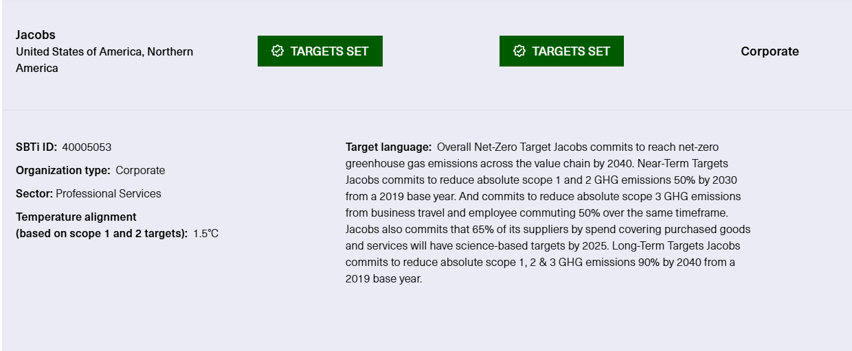
| Jacobs Solutions Inc. | Reduce business travel and employee commuting emissions by 50% by 2030 (vs 2019). Absolute target |
Target set under SBTi’s “Absolute Contraction” method; included travel as key Scope 3 category. |
~45,000–55,000 employees
Engineering & technical services |
Validated by SBTi |
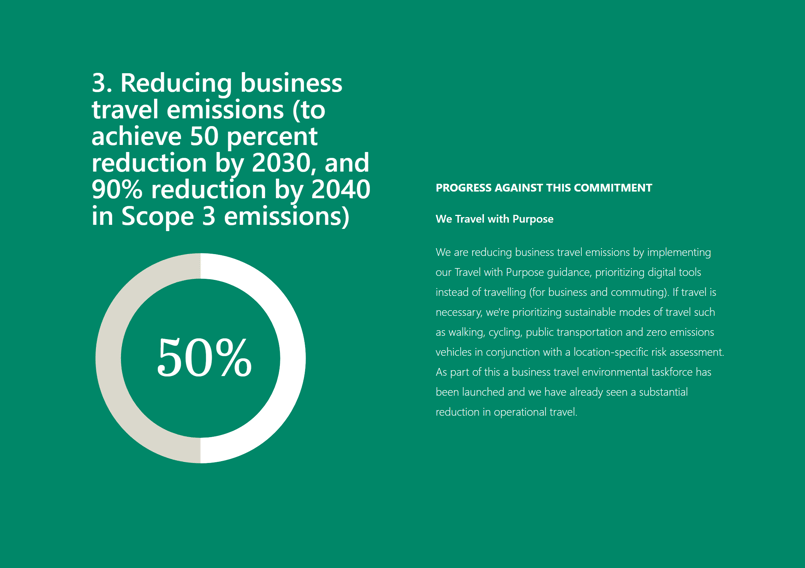
| AECOM | Reduce business travel emissions by 50% by 2030 and 90% by 2040. Absolute target |
Defined in their “Travel with Purpose” strategy; part of broader Sustainable Legacies net-zero roadmap. |
~51,000 employees
|
Validated by SBTi |
| Akind Venture AB |
Absolute target |
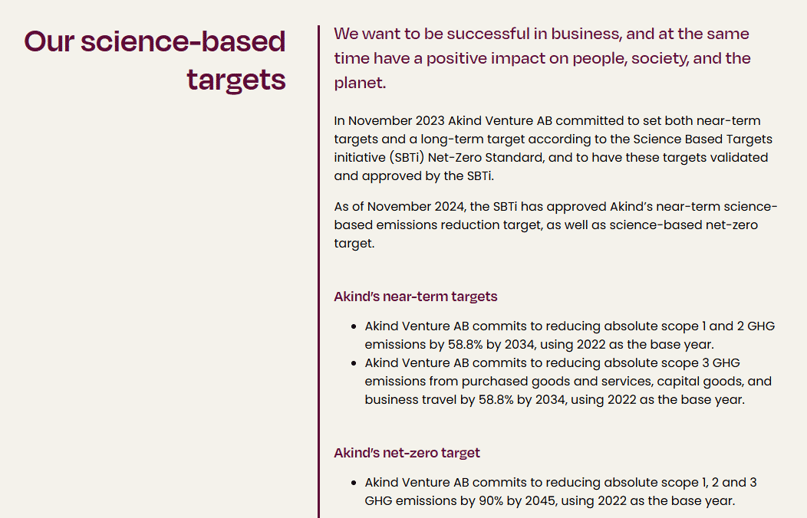
Business travel explicitly covered in Scope 3 category. Near-term and long-term targets validated under the SBTi Net-Zero Standard. |
~600 employees
Professional services / HR & staffing solutions |
Validated by SBTi (near-term + long-term Net Zero). |
|
|
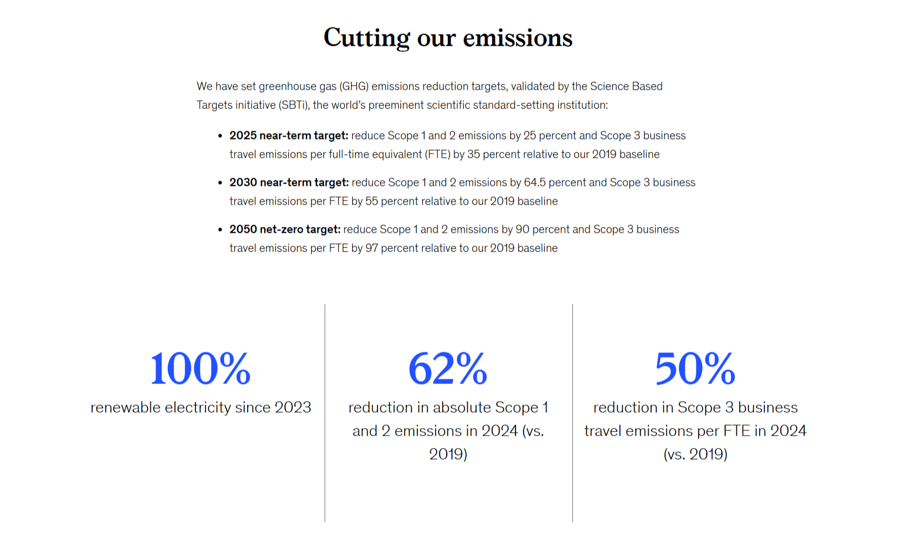
McKinsey & Company: The Intensity-Based ApproachAs a global management consulting firm, travel is integral to McKinsey's operations. The company has committed to a 1.5°C-aligned climate strategy, with a specific focus on reducing its significant travel footprint.
Image from https://www.mckinsey.com/about-us/environmental-sustainability The Target: Why It Works: Key Takeaway: An intensity-based target provides a scalable way to measure progress, making it an excellent choice for organizations anticipating changes in size or revenue.
|
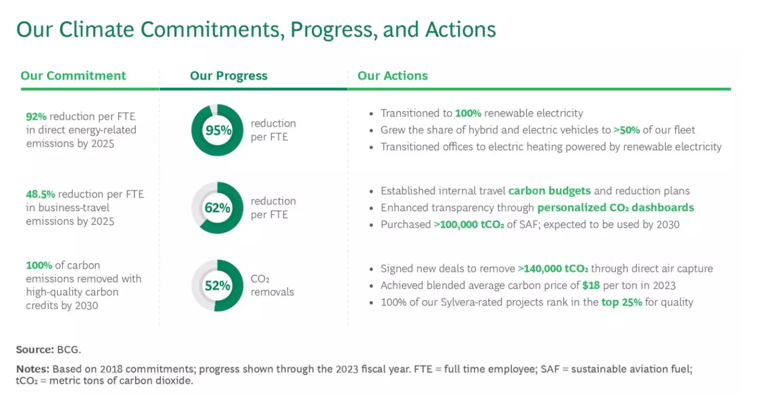
Boston Consulting Group (BCG): A Focus on Per-Capita ReductionSimilar to McKinsey, Boston Consulting Group (BCG) is another leader in management consulting where travel is a core part of its business model. BCG has embedded its climate goals directly into its corporate roadmap, ensuring accountability and public progress tracking.
Image from https://www.bcg.com/publications/2024/how-bcg-is-accelerating-its-climate-journey The Target: Why It Works: Key Takeaway: Focusing on a per-capita metric empowers individual employees and departments to contribute directly to company-wide sustainability goals. |
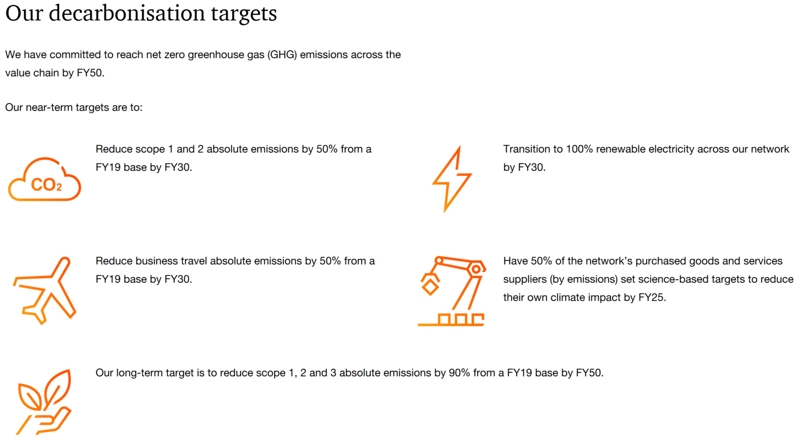
PwC (Global): The Absolute Reduction StrategyAs a vast professional services network with over 370,000 employees, PwC's collective travel footprint is substantial. The company has integrated its travel emissions goals into a broader, global net-zero plan, demonstrating a firm-wide commitment.
Image from https://www.pwc.com/gx/en/about/corporate-sustainability/environmental-stewardship/net-zero.html?
Key Takeaway: An absolute target is a bold commitment to reducing your total environmental impact, making it ideal for established companies looking to demonstrate strong climate leadership.
|
Jacobs Solutions Inc.: A Combined Scope 3 ApproachJacobs, a global engineering and technical services firm, has taken a comprehensive view of its Scope 3 emissions by including both business travel and employee commuting in its target.
The Target: Why It Works: Key Takeaway: Grouping related Scope 3 emissions categories can streamline your strategy and lead to more comprehensive and impactful reduction initiatives. |
AECOM: A Multi-Stage Reduction PlanAECOM, an infrastructure consulting and engineering firm, has defined its emissions reduction journey with a long-term vision, setting targets for both the medium and long term.
Why It Works: Key Takeaway: Setting near-term and long-term targets creates a clear, phased roadmap, making ambitious goals feel more achievable while maintaining momentum. |
Akind Venture AB: Net-Zero for the Entire Value ChainAkind Venture, a professional services and HR solutions company, demonstrates that organisations of all sizes can set ambitious, science-aligned goals. Their target is part of a comprehensive commitment to achieving net-zero across their entire value chain.
The Target: Why It Works: Key Takeaway: Aligning your travel emissions target with a broader net-zero commitment ensures that your efforts are part of a cohesive and credible long-term strategy. |
These case studies show there is no one-size-fits-all solution, but they offer clear principles to guide your own target-setting process. Learn how to set targets for your company, and how Goodwings will help you set travel emission targets - and achieve them - In our guide to setting travel emission targets.
Look at what similar companies in your industry are doing. If you are an enterprise business, what have businesses of similar size and emissions set targets for? This helps you set a target that is competitive, credible, and ambitious yet realistic.
Using frameworks like the Science Based Targets initiative (SBTi) adds credibility to your goals and ensures they are aligned with what the latest climate science says is necessary to limit global warming.
Your travel emissions target should not exist in a silo. Embed it within your company’s overall sustainability or ESG strategy to ensure it has the visibility and support needed to succeed.
By drawing inspiration from these real-world examples, you can move from simply tracking your emissions to setting a clear, actionable, and impactful travel emissions target.
Explore Goodwings and learn how to revolutionize your corporate travel. Book a demo today.
Get a quick intro to the Goodwings platform with our on-demand video demo.
Set travel emissions targets with clear baselines, ambition frameworks, mitigation levers and actionable sub-targets for measurable progress.
Discover how SAF can drive the transition to fossil-free travel, its environmental benefits, and the obstacles to its widespread adoption.
We are thrilled to announce that Goodwings has received the prestigious Innovation Award from VDR - The German Business Travel Association at the...
See how Aasted manages business travel in line with its B Corp commitments, and how interdependence and B Corps supporting B Corps drive real...